
Small Caps Live Weekly Summary
ALU CAPD CRST GTC HEAD NTBR PMI

Here’s a selection of what we looked at this week. (Remember this is a summary of many opinions, and isn’t the view of any one commentator; check out the actual discussion on Discord if you want the nuance of the different opinions.) To avoid spam, the only way for new members to join the Discord server is via the Small Caps Live website. This will be instead of direct invites via Discord. All genuine investors are still very welcome to join in the discussions.
Alumasc (ALU.L) - CEO Suspension & Trading Update
With a Friday update, we were expecting the inevitable profits warning, but not this:
…CEO, Pamela Bingham, has been suspended by the Board pending an investigation into matters relating to her professional conduct. The Company is undertaking a full investigation, supported by its professional advisors.
The CEO only joined in March, so perhaps the best that can be said is that whatever the issue is, it can’t have done that much damage to the business in that time. Not that it needed any help in this regard, with this now the third warning in a row:
…Group has delivered a performance broadly in line with the expectations set at the Q3 trading update,
The last warning took 24% out of EPS, but the market largely shrugged this off. Perhaps because the one before took a more modest 6% out of EPS, but led to a bigger fall than that.
At least they give us specific guidance:
Against this backdrop, we have delivered a resilient performance, with revenue and UPBT of £107m and £10m respectively, broadly in line with revised market consensus
Cavendish takes a further 12% out of adjusted EPS this time, giving around a 35% cut overall. However, they argue it is temporary, citing a significant increase in the order book. The company say:
Encouragingly, a refocused commercial strategy is starting to gain traction in key markets, and we exit FY26 with a strong order book, up 49 per cent compared to June 2025.
But the company doesn’t actually give us the figure. Nor can we see the figure in the Results to 30th June. Perhaps the only numbers we can use to calibrate this are the figures in the HY results. At the time, we commented that:
But Water Management had an orderbook of £7.6m, versus £22.7m revenue in H1 and Building Envelope £6.9m versus £19m revenue. This is only 2 months of revenue (for a relatively weak H1), and Cavendish doesn’t provide segmental forecasts, but logic dictates that this is likely to be less than 2 months of the revenue in each division in the bag.
Assuming the order book was similar at FY25 to 26H1 and is now 49% higher, it has increased from 2 months of 26H1 revenue to 2.3 months of FY27 revenue, based on the Cavendish forecast for FY27. It hardly seems something to get excited about.
And on profitability, it is highly likely that they have booked a whole load of exceptionals to get there, as they usually do. Perhaps the only saving grace is that the operating cash flow largely matches EPS, suggesting much of the massaging is non cash, at least in the short term.
There is an argument to be made that the whole sector is depressed and will bounce back once the housing market recovers. The question is why would you choose Alumasc for that play when it still trades at over 10x a highly adjusted EPS number, with a suspended CEO and a clear set-up for a fourth profit warning, versus a sector that is typically on 5-6x earnings at the moment?
Capital (CAPD.L) - Q2 Trading Update
These numbers look strong:
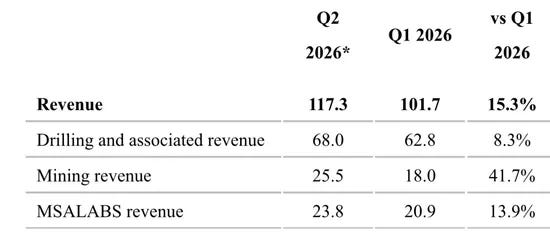
Perhaps we haven’t been following this closely enough recently, but this came as a big surprise to us:
During the quarter, we began demobilising from our drilling operations at the NGM complex in the USA and Sadiola in Mali, with equipment being redirected to higher‑returning opportunities across our existing portfolio.
We are not sure if previously flagged that they were effectively exiting the US, which was meant to be their big growth area
Ahead, but not ahead because of this:
The underlying performance across the broader operating business has exceeded our expectations while we will incur non-recurring termination and demobilisation costs associated with NGM and Sadiola, which will largely offset the better-than-expected performance in this first half period. We view these actions as an important step in optimising the portfolio for the medium term.
We are not sure that moving rigs should be considered exceptional for this business.
The good news is that there appears to be little change to the Reko Diq outlook as Barrick have reduced the pace of development:
Our operations at Reko Diq performed in line with our contract and our new waste mining contract at Sukari has ramped up faster than expected. MSALABS delivered another strong quarter and we were pleased to announce our joint‑venture with Mari Minerals in Pakistan, alongside increasing utilisation and several new laboratories expected to be commissioned later in the year.
Overall in line:
Revenue guidance for 2026 is reiterated as $410 - $440 million as previously guided at our FY25 results, reflecting the diversification of the Group and the strong demand environment; · The better-than-expected performance across the broader operating business in H1 will be largely offset by the one-off costs associated with the demobilisation at NGM and Sadiola;
It’s probably better than continuing to lose money to avoid losing face, but it’s certainly possible that all their efforts to diversify away from African drilling over the years (apart from MSALABS) have reduced shareholder value.
And it again calls into question the worth of these “long term” contracts.
In the past, we have seen a mining customer walk away from contracts in Africa just after Capital purchased the equipment. They never declared any termination fee. We have also seen a lab decommissioned after the unexpected closure of a mine.
The reality is that their end markets are so strong with demand for drilling and lab services that they will do well despite the headwinds. We just wish they had stuck to the African Drilling business, which remains the only bit that is proven to generate strong margins and returns on capital over the cycle.
Crest Nicolson (CRST.L) - Half Year Results
This looks like a further warning here:
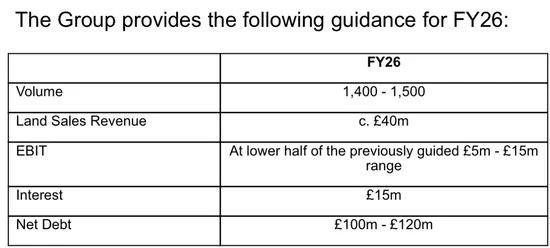
Which is perhaps not surprising when H1 looks like this:
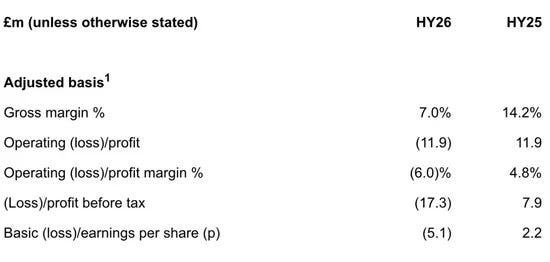
They only have a temporary covenant waiver until 30th September, rather than a more permanent package, which is also a possible disappointment.
Unsurprisingly, it’s the interest cover part that is the issue with a loss-making period. The waiver restricts them to drawing down more than £175m on the RCF, but this only becomes a problem in August 27 when £50m of notes become due.
So this buys them some time to sort things out.
Net assets down £38m:

Of which £29m is intangible.
This still compares very favourably to a £174m market cap. You have to assume an absolutely huge write-down to their land bank for there not to be value here. The big question is, will they survive to see the benefit of that? This week’s results don’t give an immediate resolution, but nor to they bring things to a head.
Getech (GTC.L) - Trading Statement & Contract Win
The good news is that they are growing again:
Trading strengthened over the course of the six-month period leading to the Company expecting revenue growth of 15% to £2.4m (H1 FY25: £2.1m) driven by a positive mix of new and retained business.
But this only just turns into +ve EBITDA:
This increased sales level and actions taken to reduce the cost base by c. 20% in 2025 have led to adjusted EBITDA improving to £0.2m versus a loss in the comparable period last year (H1 FY25: loss of £0.1m).
Other metrics are finally heading in the right direction, and cash is now building again:
Cash at bank on 30 June 2026 of £0.6m (FY25: £0.2m)
However, none of these metrics is really going gangbusters.
This is the most positive outlook statement for a while though:
Getech’s core markets, the Oil & Gas, Mining and Natural Hydrogen sectors, have seen increased exploration activity. This combination is expected to be reflected in the Company’s future performance given Getech’s proven credentials in identifying and de-risking new exploration projects.
Backed up by:
…we remain comfortably in line with market expectations for FY26.
So perhaps a chance of a beat, which would mean they had a very strong H2.
It still wouldn’t scream value on those metrics even with a modest beat, but FY27 forecasts show that it wouldn’t take much extra revenue for the numbers to look significantly better, and the cash flow would mean they’d have generated a third of their market cap in cash in 2 struggling years.
So still all to play for. But can they deliver? Today’s update suggests they may be in a better place to do so than in the recent past. As does the arrival of a contract win:
Getech, a leading locator of subsurface resources, is pleased to announce it has signed a multi-year agreement with a European‑headquartered oil and gas super‑major for access to its industry‑leading Globe platform. The new contract has a total value of $660k to be recognised over three years as annual recurring revenue.
£164k/year isn’t huge, but a new Super Major client is great signalling, and this will be high margin for a business where small amounts matter.
However, at this size, there is a question of whether they should be listed at all. Get rid of the board and listing costs, and profitability jumps materially. Most holders would presumably prefer some kind of different corporate action. The Globe database and tools clearly have value if Super majors use them, and there are data-first companies doing work in this space on huge multiples. You could probably argue for paying £5m for the business just to get you in the door on the sales call with the Super-majors! But whether they will ever generate sufficient returns from the current corporate structure to do more than pay salaries is open to much debate.
But it wouldn’t take much extra revenue for some serious operational gearing to kick in. But at this market cap range, and given recent history, it is firmly in the punt, not investment category. That is probably why we are seeing people using the recent good news as liquidity to exit rather than an opportunity to buy.
Headlam (HEAD.L) - Trading Update
We’re used to this sort of update by now:
For the Period, the Group has incurred significant operating losses, higher than H1 2025, reflecting the impact of reduced revenue offset somewhat by cost savings already achieved.
No light at the end of the tunnel:
More recently, post-Period-end, trading to date in July 2026 has been consistent with that seen in June.
And Basic maths suggests that the huge operating losses continue:
The Group’s net debt at the end of the Period was £(36.2)¹m compared to £(31.4)m at 31 December 2025, reflecting the impact of ongoing operating losses and one-off transformation costs offset by previously announced property disposal cash receipts of c.£15.3m.
This doesn’t sound good:
The Group is in regular dialogue with its lenders and continues to carefully manage day-to day operations and liquidity within its existing facilities.
That dialogue presumably involves the lenders repeatedly shouting “give us our money back,” and it sounds like the “within existing facilities” bit isn’t going to last for long:
These include, but are not limited to, and could combine, further support from its existing lenders, the sale and leaseback of the Coleshill HQ, further property disposals, a wider group refinancing, new partnerships and other broader corporate actions. Specifically, a refinancing process for the Group’s debt package is progressing at pace and financing offers have been received that would, if completed as currently proposed, advance additional liquidity to the Group.
It just smacks of too little, too late. They should be closing sites and consolidating, not selling and leasing back property.
The Strategic Review does not include seeking potential offers for the Company.
More fool them, as this looks like the only way out at this point.
Northern Bear (NTBR.L) - Preliminary Results
These headlines feel a bit confusing:
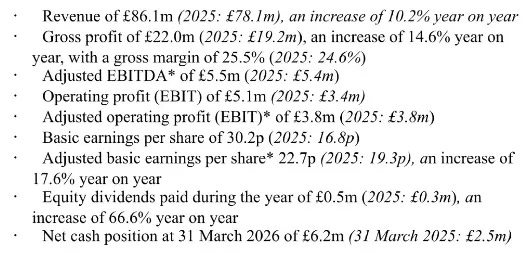
Adjusted EBITDA is flat, but adjusted EPS is up 18%, for example. Higher interest earned and lower financing (lease) charges are probably the difference.
However, what stands out is that they hold a huge net cash position for a £14m market cap company, resulting in another special dividend:
A final dividend of 2.5p per ordinary share is proposed. In addition, a special dividend of 5.0p per ordinary share is proposed to reward shareholders, following the excellent trading performance in FY26 and reflecting the non-recurring exceptional profits in that year.
Not all that is free cash, though, as customers’ prepayments play their part:
The lowest cash position during FY26 was £0.6 million net cash, the highest was £6.2m net cash and the average was £3.3m net cash.
Wish all companies would report these details as it would make getting to the heart of investment valuations so much easier. Even £3.3m average cash moves the valuation needle significantly when the company is trading around 5x adjusted earnings (adjusted down in this case).
However, the outlook suggests that even on an adjusted basis, FY26 may have been too good to repeat:
The latest expectations for FY27 are for underlying revenues to remain broadly consistent with the excellent underlying results in FY26 , notwithstanding our significant investments in both personnel and premises intended to generate further future opportunities and mitigate the negative effects of the present economic outlook.
Revenues flat and costs up suggest a weaker year for profit. This is already as forecast. However, the market rarely likes lumpy trading, so this may explain why the company still has a very low valuation.
However, trading is inherently hard to predict, and management are often conservative in guidance. The current period of exceptionally dry weather may provide another period of exceptionally positive trading, too.
Premier Miton (PMI.L) - Q3 Aum Update
Huge outflows, and unlike Impax they haven’t been saved by market performance:
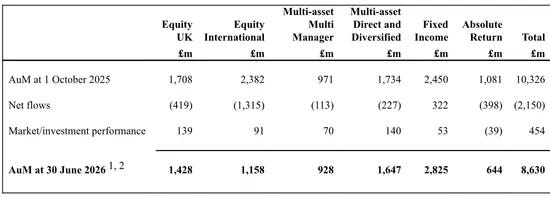
Almost 10% of current AUM in net outflows in one quarter is pretty catastrophic in a very positive quarter for markets.
Adjusted EPS is only reduced by 7% by Cavendish, but surely this is too optimistic given those flows?
The broker forecasts a significant increase in AUM in the next FY, which seems a triumph of hope over judgment!
That’s it for this week. Have a great weekend!