
Small Caps Live Weekly Summary
ARC CMCX GDP KOO LTHM SDG TRI WYN

Here’s a selection of what we looked at this week. (Remember this is a summary of many opinions, and isn’t the view of any one commentator; check out the actual discussion on Discord if you want the nuance of the different opinions.) To avoid spam, the only way for new members to join the Discord server is via the Small Caps Live website. This will be instead of direct invites via Discord. All genuine investors are still very welcome to join in the discussions.
Arcontech (ARC.L) - Trading Statement
An £800k win over 3 years doesn’t get the heart racing per se, but for a £2.5m enterprise value software company, signing £275k of ARR is actually quite significant:
Following a successful bidding process, Arcontech has signed a 3-year contract with a total value of approximately £800k with a major European bank for deployment of its software in various areas within its trading infrastructure. The contract is with a new customer and has strong expansion potential across the customer's wider market-data estate, with revenue recognition expected to commence in calendar Q3 2026.
It’s also a new customer - demonstrating that Arcontech can actually sign new customers is important signalling, as it is something they have struggled with recently. Trading is said to be in line overall, making the EV/EBIT of around 5 look very low. Even more so, if you believe the FY27 estimates, which drop the EV/EBIT to around 3. The market obviously fears that customers will gradually leave over time; there was a modest downsizing from one customer impacting this year, for example. However, if this is the start of a series of customer wins instead of exits, any future growth at all would make the current rating look a bit daft.
CMC Markets (CMCX.L) - Trading Update
Another big beat here:
As a result, CMC now expects net operating income for FY2027 to be at least £550 million, materially ahead of previous guidance of £460 million to £480 million, with EBITDA guidance of £250 million.
FY2027 guidance for operating expenses excluding variable remuneration of approximately £280 million remains unchanged.
Despite the scale of the upgrade, the share price move here look slightly bonkers, given that volatility can disappear as quickly as it arrived. There is pretty huge operational gearing, and we are seeing the benefit of that in the results. It is just very hard to judge if the current strong NOI performance is anything other than vol exposure. The company claim that it is due to:
The strength of this performance reflects the scale of our B2B platforms driving operational gearing and delivering higher profit margins as income growth is delivered against a largely fixed cost base.
However, we are more sceptical. It’s certainly possible that this is the case, but the FY26 numbers to 31st Mar were pretty much all a miss to the consensus on the company website. If this really has become a higher quality business, less dependent on vol, why did that jump in quality suddenly occur around March this year?
Instead, if this strength is due to a commodity price rise (volatility is essentially like a commodity for this business), then investors shouldn’t pay up for a single great year. The forward P/E isn’t crazy. The issue is whether a P/E is a good measure for a highly cyclical business. If it is, you probably need to try to estimate the underlying trend earnings and growth, and apply the P/E to that, not this year’s estimates. Easier said than done, which is why so many investors simply buy momentum and hope they are quick enough to get out when it turns.
Goldplat (GDP.L) - Trading Update
Some fairly basic maths told us this would be the case:
As a result of the continued high gold prices and strong volumes, and subject to a number of year-end adjustments, the Board expects that the Group’s results for FY2026 will materially exceed prevailing market expectations.
Still, nice to have it confirmed.
The timing of this update is a day after year-end, when they won’t have a month-end close, so they won’t have management accounts. It shows how confident they must be that Q4 was good.
The mention of volumes being good and no mention of recent gold price weakness are positives too, (not that this company has anywhere near the gearing to the gold price that miners have, there is exposure through inventory).
A lot of evidence suggests we should simply be buying companies that report “materially ahead” statements, no matter how strong recent price action has been, and in this case, this is the second “materially ahead” in a row. A few of us had an interesting debate as to whether buying commodity companies that report materially ahead statements makes sense. [See CMC markets above, too.] We sort of came to the conclusion that it depends where the beat comes from; if it is better than planned operational performance, it probably makes sense, less so for those statements driven by commodity pricing alone.
Strangely, we have still seen no actual update from their broker to guide us to the scale of the beat. We should get Q4 operating results from the company at the start of August, which means that we should be able to come up with our own rough figures. As usual, there is a huge edge available to investors at this market cap level for investors willing to do their own basic maths, instead of trusting broker numbers as gospel.
Unless the broker gets its act together and delivers a big jump in EPS in its forecasts, we could well be in for the third materially ahead statement in a row. Despite recent price strength, this remains one of the cheapest-rated stocks on the UK market. If management manages to avoid the banana skins that plagued their tenure earlier on, and deliver further EPS growth next year, a more material re-rating from their current 1x EV/EBITDA is sure to follow, despite the obvious risks of operating in this sector and geographies.
Kooth (KOO.L) - Broker Update
We are often critical of brokers’ notes. Brokers are obviously paid to put the company’s best foot forward, and it can often lead to notes being released for the most spurious of reasons [or not released at all, in the example of Goldplat above]. However, in this case, the broker appears to have picked up something that most of us would have missed:
If the State of California were to have given notice for the cancellation of the contract by June 2027, we would expect to have been alerted by today. On the contrary, on the 29th June, California’s Governor Newsom released a Children and Youth Behavioral Health Initiative (CYBHI) Legacy Report, naming Kooth’s Soluna as a core element of the success of the CYBHI, as well as announcing a balanced budget for California for 2026/7 ensuring the continued funding of healthcare. It is clear that the relationship will persist; and as we have repeatedly noted, will continue in an expected format…
The share price remains below the level when the market started to worry about the contract renewal and unexpected marketing spend. Both concerns appear to have proven to be unfounded.
James Latham (LTHM.L) - Final Results
Volumes up 7.7% LFL looks good. Although EPS is only up 2.7%, which shows the margin pressure:
Profit before tax is £25.1m, compared with last year's £24.3m. Profit after tax for the year is £18.6m compared with last year's £18.1m. Earnings per ordinary share is 92.5p compared with last year's 90.1p.
They appear to have avoided the warnings plaguing the sector, so this is probably a strong performance given the circumstances.
Cash of £51m looks reasonable, given they have started to spend on the National Distribution Centre. However, we would have liked a more detailed update on this, including where we are in the spend profile, to gauge the likely cash level to use in any valuation. We are still in the “trust us, this is going to be good” stage of this development. And if there is a management team you would want to trust with long-term investment, it would be this one. However, we have never been given any insight into why an NDC makes sense in a financial way.
Interestingly, there is a time-lapse camera of the National Distribution Centre available.
Sanderson Design (SDG.L) - AGM Statement
H1 trading similar to H2 last year. In line, but sounding fairly confident:
As announced in its Full Year results published on 29 April 2026, the Group entered the current financial year (”FY2027”) with good momentum and similar trading trends to that seen in the second half of FY2026.
This momentum has been sustained with the Group delivering year-on-year growth year-to-date. Consequently, expectations for the full year are unchanged.
The share price has been strong recently. However, in the final results, we found out that the company had lent money to its EBT to purchase shares, which appears to have been aggressively buying. However, we had no idea this was going on until then. We also have no idea when they will finish buying (surely sometime soon?), and given the illiquidity, the share price could well give back all of its recent gains when the EBT stops buying.
We were hearing rumours that some shareholders aren’t happy with the board here, so we thought the AGM voting may be interesting. As it happened, around 26% of those who voted voted against the Chair, a NED, and the Remuneration Report.
The most likely candidate is the company’s largest holder, LBV Asset Management. Things could be about to get messy here, and for the sake of smaller shareholders, we hope the distraction of a boardroom battle doesn’t damage the business.
Trifast (TRI.L) - Final Results
When one of the main highlights in the RNS title is:
Clear line of sight to 10%+ EBIT margins
But they’ve had to reduce revenue to achieve the current EBIT margin improvements:
Revenue down 7.3% to £207.1m (CER) and down 6.7% to £208.4m (AER) (FY25: £223.5m), as anticipated, reflecting softer market demand alongside the strategic decision to focus on the quality of revenue.
…you know things aren’t exactly going well. They even had to break out the dreaded “R-word”:
Resilient FY26 performance delivered through disciplined execution, despite a challenging macroeconomic and geopolitical backdrop.
Investors also need to ask if they are happy that the company have to exclude a huge chunk of IT costs to get to that heavily adjusted number?
Profit before tax was £0.1m (AER) (FY25: £4.9m), after Separately Disclosed Items, including £6.0m of Project Ignite costs expensed in the year rather than capitalised, reflecting the accounting treatment for cloud-based implementation costs.
We assume that they aren’t going to adjust out the benefits they achieve from the new IT system in future years. And even if they were allowed to capitalise the spend, they may well adjust out the amortisation.
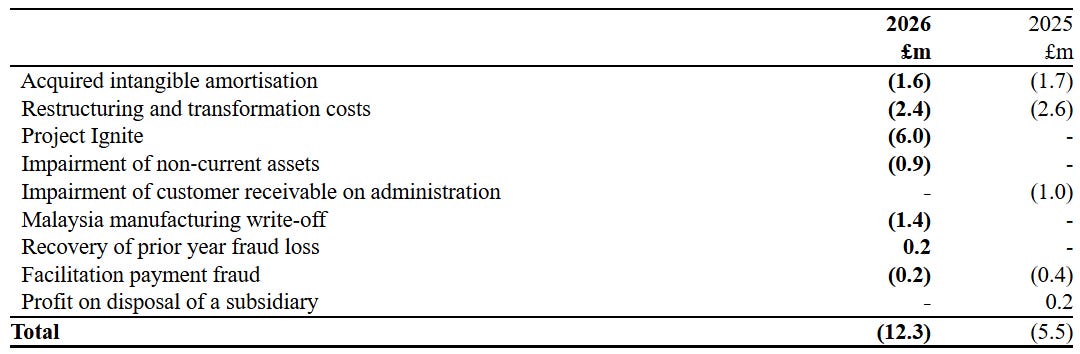
If at first you don’t succeed, adjust, adjust, adjust again.
Wynnstay (WYN.L) - Interim Results
These aren’t bad, but many of us were expecting a big inventory gain on fertiliser to lead to much stronger results than these:
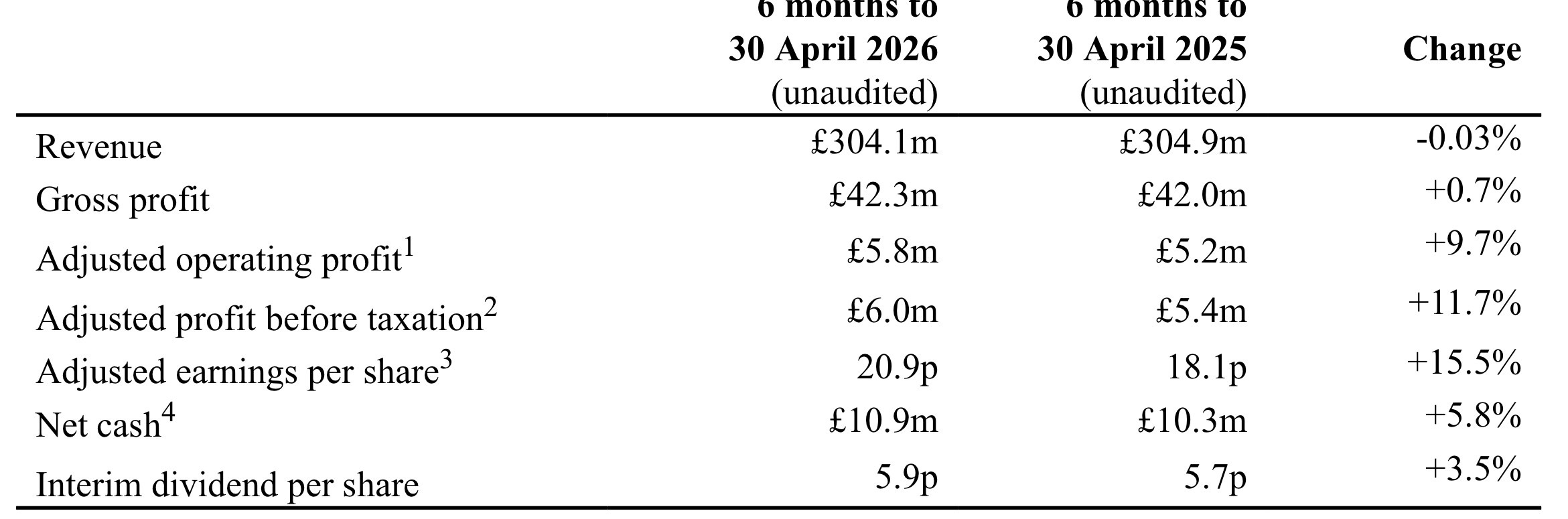
This is what they said on the topic:
Fertiliser markets experienced short-term volatility following geopolitical developments in the Middle East, providing a modest benefit to profitability through well-managed purchasing positions.
It seems the benefit was a very modest c£0.3m, and turned out to be nowhere near the scale of the impact on 2022, which was our benchmark for expecting stronger results:
While this provided a modest benefit to profitability, the impact was significantly lower than the dramatic market increases experienced following the outbreak of the conflict in Ukraine during 2022. Market movements were less pronounced, not all product categories experienced price increases and much of the spring season had already been contracted before prices moved higher.
The forward sales to arable farmers were well known, but considerable free stocks were indicated at the AGM. In these results, inventory was down to £50m from £53m, so the effect doesn’t appear to be shown in as yet unrealised gains. Without the fertiliser gain and Project Genesis, it looks like these interims would have been pretty bad. But this also underlines the good job Alk is doing in challenging conditions.
Their broker Shore say:
While key trading periods are still ahead reflecting the seasonal farming calendar, market conditions remain mixed with a risk of input cost inflation, so we leave our FY26F expectations unchanged at this stage. We would rather err on the side of caution, given the moving parts reflecting the significant uncertainty around the Middle East and the impact of higher fuel prices.
Weighting by half is a bit hard to estimate, as weather factors and inventory gains/losses each play a role. On an underlying basis, we think the best H1/H2 weighting to use to give an “outside view” of FY figures is 60/40. 20.9p H1 EPS then implies 35p FY. Adjust for non-recurring fertiliser gains, and you get 34p for the full year, implying a little less conservatism than last year in the 31.6p forecast. Fortunately, we appear to be in for a “good” rather than a “normal” harvest, providing some scope to beat further and a potentially good H1 from ongoing GrainLink sales and better farmer confidence.
However, a P/E of around 11 isn’t exactly cheap for this type of business, so the market is already pricing in Project Genesis to continue to improve historically very low returns on capital, and one of the legs of the investment stool (that investors would get excited about a big H1 EPS figure on one-off inventory gain, as they did in 2022), has been kicked out from under them this week.
That’s it for this week. Have a great weekend!